Sunday Morning Book Thread - 9-20-2026 ["Perfessor" Squirrel]
Click for larger image
Welcome to the prestigious, internationally acclaimed, stately, and illustrious Sunday Morning Book Thread! The place where all readers are welcome, regardless of whatever guilty pleasure we feel like reading (Yoko Ono edition!). Here is where we can discuss, argue, bicker, quibble, consider, debate, confabulate, converse, and jaw about our latest fancy in reading material. As always, pants are required, unless you are wearing these pants...(is there a sincere pumpkin patch near you?)
So relax, find yourself a warm kitty (or warm puppy--I won't judge) to curl up in your lap, and dive into a new book. What are YOU reading this fine morning?
PIC NOTE
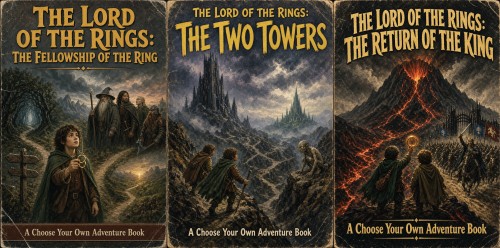
Earlier this week I had a dream where I was flipping through a stack of books in a library or bookstore and came across a "Choose Your Own Adventure" version of Lord of the Rings. For some reason, that tickled my fancy, so I asked Grok to generate covers for each of the volumes of Lord of the Rings as if they were each a "Choose Your Own Adventure" book.
Then I wondered, "How would that even work?" Who would be the main viewpoint character? Frodo or Sam would do for that up to a point (until the Fellowship split up in The Two Towers). What sort of decisions would the reader have to make to reach the canon outcome? What are the alternative outcomes? Anyway, I just found it amusing to imagine the greatest fantasy epic of all time as a "Choose Your Own Adventure" book.
Note that Grok did get an extremely important key detail wrong on the cover of its version of Fellowship of the Ring, which I also found amusing.
Which book would YOU like to see as a "Choose Your Own Adventure?"
CAN'T YOU FEEL IT CALLING? (EMPIRE!)
At the risk of being permabanned, I'm starting this section with a lyric from Queensrÿche's classic song "Empire."
For the past several month, every book I've read has featured an Empire of one sort or another. Either the Empire is front and center (Dune) or the Empire is an integral part of the background in the author's worldbuilding (Ana and Din Mysteries).
Empires tend to follow a cycle, as noted by TVTropes.org.
In the Expansion phase, the Empire is still growing and seeking to conquer new territories. The Empire may be very young, having come into existence within a few decades. The Malazan Empire from the books written by Steven Erickson is this sort of Empire. It's constantly attempting to find new lands. During this phase, a lot of effort will be spent on military adventures, as new resources flood into the expanding empire, allowing it to continue its growth. You will also see lots of intrigue and betrayals, as those responsible for expanding the Empire see opportunities to create their own fiefdoms under their direct control.
The Stabilization phase is where the Empire needs to consolidate its control over its new citizens, reminding them in no uncertain terms just who is now in control of their lives. The Catenan Empire is James Islington's Hierarchy series is in the process of stabilizing its control over the continent, now that its eliminated any competing systems of government. Naturally, there are elements of rebellion that crop up. The Empire will also seek to consolidate any new resources it may have acquired in an effort to pay off any debts its incurred due to the war effort. The Empire also need to figure out what to do with a massive military industrial complex that now doesn't seem to have much purpose as there are no more territories to conquer. The Empire may still do some expansion if there are some areas that they've left alone because they were not worth the effort to acquire earlier, if only to continue a path for growth forward. The Empire in the Ana and Din Mysteries by Robert Jackson Bennett is in this process. There are still some outlying areas beyond its direct control, but its seeking to acquire them through peaceful, diplomatic means rather than outright conquest.
Once an Empire has stabilized, there's really no place else to go but down. The Decay will soon set in. Corruption and graft will become the normal state of being during this phase. Characters may still be noble, clinging to an upright moral code while those around them sink into decadence and hedonistic pleasures. The Empire may be ruled by weak men and women, heirs of their previous much stronger ancestors who were able to conquer and rule with a firm hand. Administrators and bureaucrats may ultimately decide that THEY are in charge, rather than a faceless Emperor who supposedly rules from a distant capitol city or world. This is the status of the Galactic Empire at the beginning of Isaac Asimov's Foundation series.
The fourth and last phase is the Long Night, when the Empire begins to slowly decline into irrelevance. The Empire may rule in name only as various factions and warlord squabble amongst each other to acquire their own power bases. The Long Night can last for centuries or even millennia. In the Dune series by Frank Herbert, God Emperor Leto II's goal is to shepherd the Galactic Empire through this phase so that humanity is able to come through the other side as a species, despite the massive destruction that will occur along the way. The purpose of the Foundation in Asimov's series is to minimize the Long Night from the estimated 30,000 years to a mere 1,000 years or so until the next Empire can arise in its place.
Empires in fantasy and science fiction usually take inspiration from one or more examples from history. The Roman Empire is a frequent template for fictional empires. It was large, powerful, lasted a long time, and we have copious documentation from that time about how the Roman Empire functioned. Several of the series I've been reading recently take direct inspiration from the Roman Empire, such as Islington's Hierarchy series and Bennett's Ana and Din Mysteries, with faux-Latinate terminology sprinkled throughout the story.
A few series will mix and match Empires, again based on real-world historical Empires, to lend an air of authenticity to the story. Raymond E. Feist's Riftwar Saga, for example, has three distinctive Empires. The Kingdom of the Isles spans an entire continent and is based on a medieval British-style governing system, with a King, Dukes, Barons, Earls, and so forth. South of the Kingdom of the Isles is the Empire of Great Kesh, which occupies the southern continent and is modeled after an African/Middle Eastern Empire. On the distant world of Kelewan, we have the Empire of Tsurannuani, which is very much pattered after a Japanese/Asian culture, with Buddhist elements thrown in for good measure.
In stories that feature Empires, the main conflict is almost always something that can undermine or even collapse the current Imperial system--i.e., a threat to the status quo. Empires rise and fall, as is only natural, and they experience numerous inflection points during their histories. Some Empires will last millennia until they finally collapse due to circumstances beyond their control. The Empire in Dune was over 10,000 years before Paul Muad'dib came along and stole it. However, the Empire in Star Wars (under Palpatine's rule) only lasted a single generation before Darth Vader killed the Emperor to save his own son. The Imperial Remnant continued for several generations afterwards, though.
What can Empire do for you?
++++++++++
HT: Sharon (willow's apprentice)
++++++++++
HIDDEN LIBRARIES
Moronette vmom sent me this link (goes to x.com) about a Syrian man who hid his private library in the city of Damascus, Syria, to prevent the Assad regime from discovering any forbidden books, which could have led to him being imprisoned, tortured, and killed. The old man returns to Syria now that Assad is gone and uncovers his impressive library, returning it to its former glory in his home.
Governments around the world (including ours, unfortunately) LOVE to control the flow of information within their borders, as that gives them control over the people within them. What lengths will YOU go to to protect your collection of precious books? Which books do you consider to be the most valuable if you had to hide them from an oppressive regime? I suppose for me, the number one book would be the Bible, as it's the moral code that gives our lives meaning, one that transcends mere temporal government control. There are a few others that I might throw into the mix, especially those that would allow me to rebuild a civilization if it ever came to that.
MORON RECOMMENDATIONS
Albert Campion has been asked by a friend from college to investigate the disappearance of his fiancé's uncle. Before he even arrives in Cambridge, the body is found, and the trouble truly begins. In Police at the Funeral, Margery Allingham brings the reader a chaotic mystery that defies a simple explanation.
Great aunt Caroline is the matriarch of a dysfunctional family, and the widow of a famous professor at Cambridge. She wanted Campion involved to forestall police involvement and keep the situation quiet, but after Uncle Andrew's body is found tied with rope and a bullet hole in his head, and her son William was the last to be seen with him, it becomes impossible to keep things under wraps. William's army pistol is missing, and a shank of rope from the attic is gone as well, which all point to William.
All of Caroline's adult children sponge off of her and live in the same house in a festering atmosphere. When yet another death occurs in the house, it seems that a curse has fallen upon the family, and Campion must use all of his intuition and skill to break open the case and find the answers, however fantastical they appear. This is a classic Campion mystery.
Posted by: Thomas Paine at September 13, 2026 09:27 AM (0U5gm)
Comment: "Tied with rope and a bullet in the head?" Must be suicide, according to local police...I enjoy these types of mysteries because the reader is never quite sure "whodunnit" until the end when all shall be revealed. Every suspect has a motive, multiple suspects have the means, and may have opportunity, but only ONE will be found to have the right combination of means, motive, and opportunity to accomplish the murders. When multiple bodies start dropping, it's often a sign that the killer is panicking and beginning to make mistakes, which gives the detective the necessary clues to unravel the mystery. The detective may even acknowledge this in universe.
MORE MORON RECOMMENDATIONS CAN BE FOUND HERE: AoSHQ - Book Thread Recommendations
+-----+-----+-----+-----+
WHAT I'VE BEEN READING RECENTLY
Star Wars - Dark Lord: The Rise of Darth Vader by James Luceno
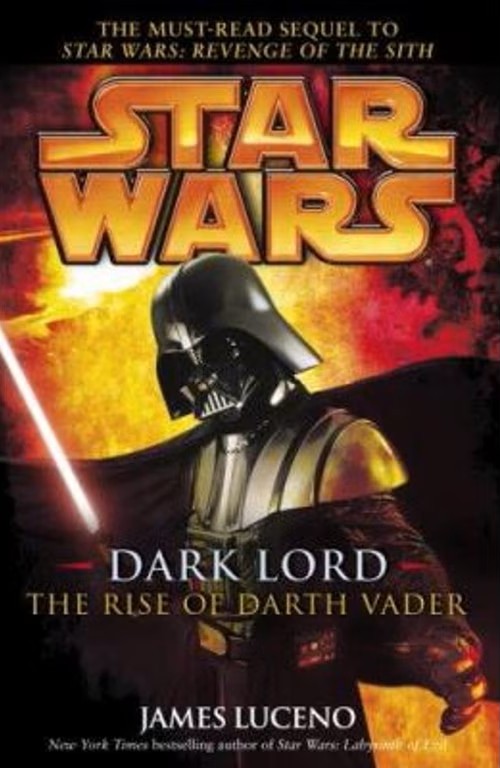
I suppose this would be an "interquel" between Star Wars - Episode III - Revenge of the Sith and Star Wars - Episode IV - A New Hope. Anakin Skywalker has fully embraced the Dark Side of the Force and become Darth Vader, Emperor Palpatine's right-hand man and enforcer of the Emperor's will throughout the Galactic Empire. However, in his early days he's very much an unknown quantity among the Imperial troops. They know he's different than they are and that he has a very high rank in the Empire, but they're not quite sure how to react to Darth Vader.
Here we get to see Vader's internal struggle as he comes to grips with what the Emperor has done to him, by providing Vader with a life-support system that is inferior to normal Imperial technology, causing constant pain and discomfort to Vader. This makes him a bit grouchy, as you might expect, so he unleashes his misery on anyone who defies him. Which of course helps establish a reputation of brutal capriciousness that will become Vader's trademark strategy for dealing with problems.
Meanwhile Bail Organa, Mon Mothma, and a few others start to plant the seeds of active rebellion against the Empire. Obi-Wan Kenobi lives in exile on Tatooine, keeping an eye on the the infant Luke Skywalker, who will turn out to be a new hope for the galaxy.
Hierarchy I - The Will of the Many by James Islington
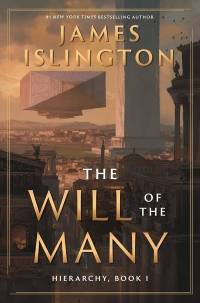
I've heard good things about this book and I enjoyed Islington's earlier Licanious Trilogy, so I decided to finally get around to reading The Will of the Many. It's about a young many who seeks to defy an Empire that crushed his homeland, but the nature of the Empire means he must work to defeat them from the inside, becoming that which he hates most.
The Empire here is very unusual, as it is literally a pyramid scheme with those at the top using the "will" of those below them to enforce their rule. It's a highly stratified society. The problem with this type of world is that it's hard to figure out how the children of the nobility inherit their rank, which is strictly based on how much "will" of those below a person possesses. It doesn't look like anyone is born possessing that much will--it has to be earned through advancement. So technically everyone starts out at the bottom. It's a very strange system of government when you start looking at it too closely.
Things get considerably more complicated after the climax of the book, but to say more would be a major spoiler.
The Tainted Cup by Robert Jackson Bennett
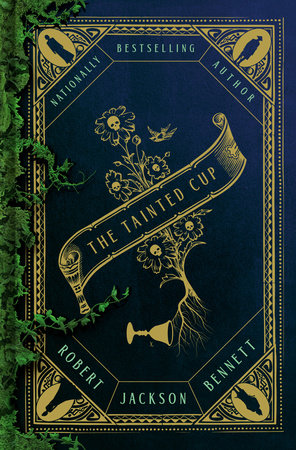
The Tainted Cup is the first book of a series that was originally called Shadow of the Leviathan but now seems to be called Ana and Din Mysteries. Bennett (and reviewers) compare these stories to Nero Wolfe mysteries, where the main detective largely sits around their lodging, cogitating on the mystery at hand, while the assistant goes out to collect the clues.
In the first book, the assistant Dinios "Din" Kol" is tasked with finding out how a prominent officer of the Empire was killed in a bizarre manner by an organism that shouldn't exist. Naturally, intrigue abounds as Din uses his enhanced memory to collect the information that he brings back to his superior officer Ana, the mind behind the detective duo.
Along the way we are introduced to a very strange world where biological and alchemical engineering are used to secure the power of an Empire that defends its people from the enormous leviathans that come ashore every wet season to wreak havoc on the countryside. The bodies of dead leviathans are also the source of the Empire's prowess, as reagents from their bodies are used as the basis for the bioengineering practices of the Empire.
A Drop of Corruption by Robert Jackson Bennett
Another And and Din Mystery, the pair of investigators are dispatched by the Empire to a remote kingdom that will one day join the Empire. Their task is to find out who killed an agent of the Imperial Treasury. Here they become enmeshed in a local political controversy as there is one faction in Yarrowdale that wants to join the Empire and another that wants to remain independent. Meanwhile, the Empire's greatest leviathan research facility remains just off shore where the Apoth faction (apothecaries and alchemists) dissect the corpses of leviathans to find out what makes them tick. The strangeness of the place warps reality itself, corrupting everything and everone that comes into contact with it, which is the cause behind all of the bizarre events in Yarrowdale.
A Trade of Blood by Robert Jackson Bennett
This is the third and most recent installment in the Ana and Din Mystery series. Ana and Din are sent to an agricultural community within the Third Ring of the Empire. It's the source of much of the Empire's food, as it's the home of the largest ranching facility as well as the home of the most important farming family. As usual, the ranching family and the farming family are at odds with one another, but there's a Romeo & Juliet subplot that connects the two families in a web of malice and deceit.
We also learn more about the Empire's history, as it turns out that several centuries ago, two Elder Races also had a conflict in the region that is the cause of the current day's woes. The Elder Races are long gone, but their legacy remains.
Tips, suggestions, recommendations, etc., can all be directed to perfessor -dot- squirrel -at- gmail -dot- com.
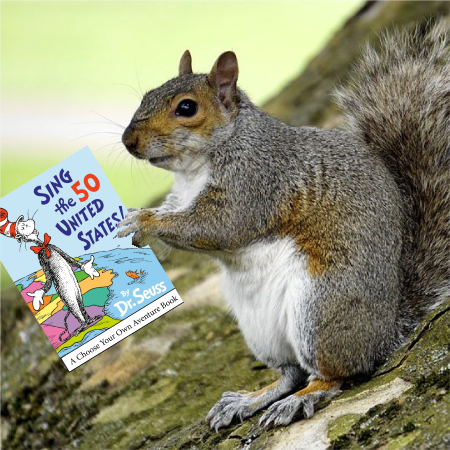
Choosing his own adventures since 2022...
Disclaimer: Breeding cats with hands and then controlling them via a brain fungus so that they can pick crops for you is not recommended.